
When the bikini skyrocketed to fame in the 1950s, it shocked the world. Women baring so much skin in public was bold, controversial, and beyond scandalous. But just a little more than a decade later, a surprising discovery inside a 4th-century Roman villa would reveal that the bikini wasn’t as revolutionary as everyone thought.
The first Bikini is Born
In 1946, French engineer and designer Louis Réard set out with one goal in mind: to create the world’s smallest swimsuit. In his own words, he wanted to create something “explosive”–something so revolutionary and disruptive that its effect would be similar to that of an atomic bomb.

Louis Réard stands next to a bikini in his Paris boutique, 1974.
With his goal in mind, Réard unveiled what he called the “bikini”–fittingly named after the nuclear bomb test site, Bikini Atoll.

The testing of an atomic bomb at Bikini Atoll, 1946.
On July 5, 1946, Réard unveiled his creation to the world at the Piscine Molitor, a popular swimming pool in Paris. And explosive, it was.
The bikini was so daring for its time that no professional models would wear it. In fact, it was a Parisian showgirl named Micheline Bernardini who would first model the design.

Micheline Bernardini is the first to model and reveal Louis Réard’s bikini to the world, 1946.
For years, it continued to be shocking, scandalous, and extremely controversial. So much so, that for years, women could be fined or even arrested for wearing them in public. In fact, in 1949, the bikini was banned from public places in many European countries and prohibited in some U.S. states.
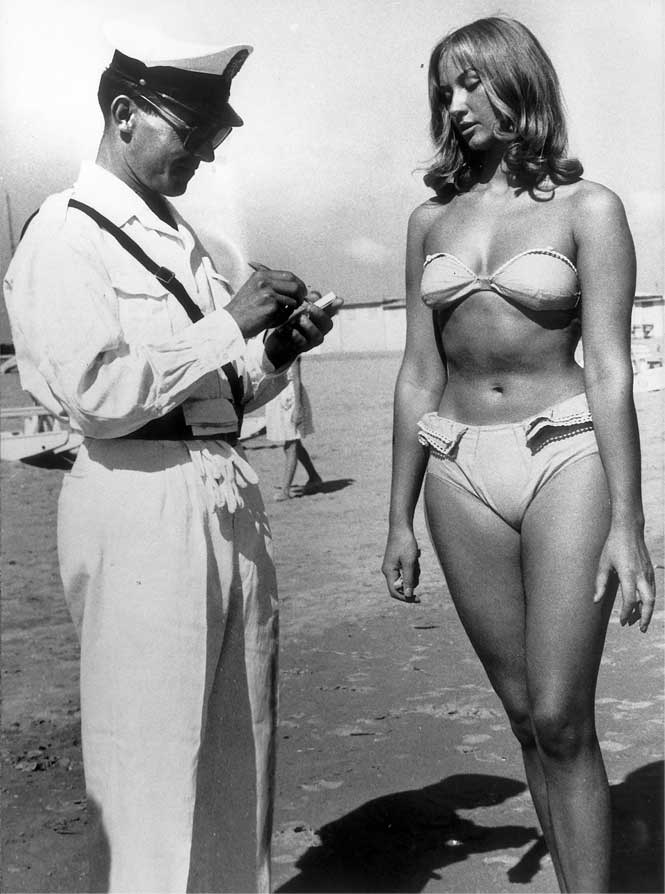
A young woman receives a ticket for wearing a bikini at an Italian beach, 1957.
An Unbelievable Discovery inside a 4th Century Villa
But just over a decade later in 1960, archeologists uncovered a mosaic tile floor inside a Roman villa dating back to around the year 320 AD. And it told a different story.
Depicted on the mosaic tile floor were eight 4th century women–running, playing sports, lifting weights–all while wearing garments that are very similar to the modern-day bikini.
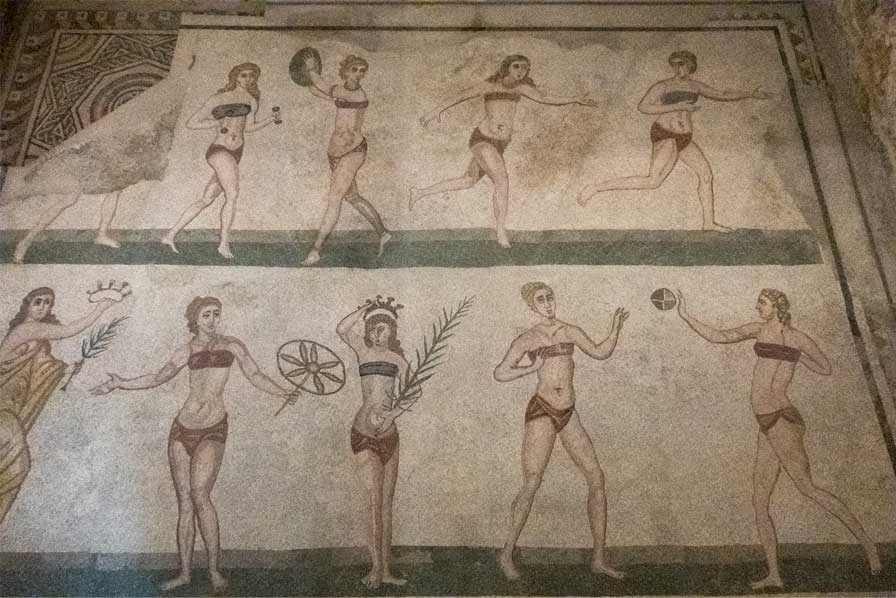
The eight Roman bikini girls mosaic located inside Romana del Casale Piazza.
Suddenly, Louis Réard’s highly controversial and “revolutionary” swimsuit wasn’t so new after all. What the world believed to be a modern invention, was in reality a rediscovery.
Back in Style—1,600 Years Later
The discovery of the 4th-century bikini mosaic did more than offer a glimpse into ancient Roman architecture–it rewrote what we thought we knew about women’s fashion, athleticism, and bodily freedom.
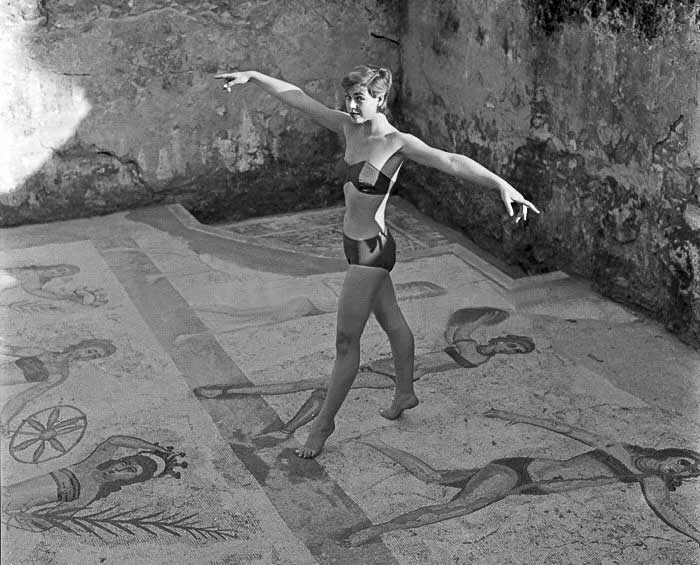
Different women. Different bikinis. Separated by centuries, united by style.
Long before modern women were shamed, fined, or arrested for baring skin at the beach, Roman women wore bikini-style garments unapologetically. Yet, somewhere along the way, as clothing became a symbol of class and status, modesty was redefined–skin, once natural and unremarkable, became taboo. For centuries, that stigma persisted. And then came the rebirth of the bikini–not as something new, but as something remembered.